

Latest DP-420 Study Guides 2023 - With Test Engine PDF
Get New DP-420 Practice Test Questions Answers
The Microsoft DP-420 exam consists of multiple-choice questions and performance-based labs. The exam covers a range of topics, including designing and implementing containers, designing and implementing Azure Cosmos DB databases, data access, and data storage. The exam also covers topics related to security, monitoring, and troubleshooting Azure Cosmos DB applications.
NEW QUESTION # 12
You have an Azure Cosmos DB Core (SQL) API account named account1.
You have the Azure virtual networks and subnets shown in the following table.
The vnet1 and vnet2 networks are connected by using a virtual network peer.
The Firewall and virtual network settings for account1 are configured as shown in the exhibit.
For each of the following statements, select Yes if the statement is true. Otherwise, select No.
NOTE: Each correct selection is worth one point.
Answer:
Explanation:
NEW QUESTION # 13
The settings for a container in an Azure Cosmos DB Core (SQL) API account are configured as shown in the following exhibit.
Which statement describes the configuration of the container?
- A. Items stored in the collection will be retained always, regardless of the items time to live value.
- B. All items will be deleted after one hour.
- C. All items will be deleted after one year.
- D. Items stored in the collection will expire only if the item has a time to live value.
Answer: D
Explanation:
Explanation
When DefaultTimeToLive is -1 then your Time to Live setting is On (No default) Time to Live on a container, if present and the value is set to "-1", it is equal to infinity, and items don't expire by default.
Time to Live on an item:
This Property is applicable only if DefaultTimeToLive is present and it is not set to null for the parent container.
If present, it overrides the DefaultTimeToLive value of the parent container.
Reference: https://docs.microsoft.com/en-us/azure/cosmos-db/sql/time-to-live
NEW QUESTION # 14
Note: This question is part of a series of questions that present the same scenario. Each question in the series contains a unique solution that might meet the stated goals. Some question sets might have more than one correct solution, while others might not have a correct solution.
After you answer a question in this section, you will NOT be able to return to it. As a result, these questions will not appear in the review screen.
You have an Azure Cosmos DB Core (SQL) API account named account 1 that uses autoscale throughput.
You need to run an Azure function when the normalized request units per second for a container in account1 exceeds a specific value.
Solution: You configure an application to use the change feed processor to read the change feed and you configure the application to trigger the function.
Does this meet the goal?
- A. No
- B. Yes
Answer: A
Explanation:
Instead configure an Azure Monitor alert to trigger the function.
You can set up alerts from the Azure Cosmos DB pane or the Azure Monitor service in the Azure portal.
NEW QUESTION # 15
You are implementing an Azure Data Factory data flow that will use an Azure Cosmos DB (SQL API) sink to write a dataset. The data flow will use 2,000 Apache Spark partitions.
You need to ensure that the ingestion from each Spark partition is balanced to optimize throughput.
Which sink setting should you configure?
- A. Batch size
- B. Throughput
- C. Write throughput budget
- D. Collection action
Answer: A
Explanation:
Batch size: An integer that represents how many objects are being written to Cosmos DB collection in each batch. Usually, starting with the default batch size is sufficient. To further tune this value, note:
Cosmos DB limits single request's size to 2MB. The formula is "Request Size = Single Document Size * Batch Size". If you hit error saying "Request size is too large", reduce the batch size value.
The larger the batch size, the better throughput the service can achieve, while make sure you allocate enough RUs to empower your workload.
Incorrect Answers:
A: Throughput: Set an optional value for the number of RUs you'd like to apply to your CosmosDB collection for each execution of this data flow. Minimum is 400.
B: Write throughput budget: An integer that represents the RUs you want to allocate for this Data Flow write operation, out of the total throughput allocated to the collection.
D: Collection action: Determines whether to recreate the destination collection prior to writing.
None: No action will be done to the collection.
Recreate: The collection will get dropped and recreated
NEW QUESTION # 16
You maintain a relational database for a book publisher. The database contains the following tables.
The most common query lists the books for a given authorId.
You need to develop a non-relational data model for Azure Cosmos DB Core (SQL) API that will replace the relational database. The solution must minimize latency and read operation costs.
What should you include in the solution?
- A. Create a container for Author and a container for Book. In each Author document and Book document embed the data from Bookauthorlnk.
- B. Create a container that contains a document for each Author and a document for each Book. In each Book document, embed authorId.
- C. Create Author, Book, and Bookauthorlnk documents in the same container.
- D. Create a container for Author and a container for Book. In each Author document, embed bookId for each book by the author. In each Book document embed authorId of each author.
Answer: D
Explanation:
Explanation
Store multiple entity types in the same container.
NEW QUESTION # 17
Note: This question is part of a series of questions that present the same scenario. Each question in the series contains a unique solution that might meet the stated goals. Some question sets might have more than one correct solution, while others might not have a correct solution.
After you answer a question in this section, you will NOT be able to return to it. As a result, these questions will not appear in the review screen.
You have an Azure Cosmos DB Core (SQL) API account named account 1 that uses autoscale throughput.
You need to run an Azure function when the normalized request units per second for a container in account1 exceeds a specific value.
Solution: You configure an application to use the change feed processor to read the change feed and you configure the application to trigger the function.
Does this meet the goal?
- A. No
- B. Yes
Answer: A
Explanation:
Explanation
Instead configure an Azure Monitor alert to trigger the function.
You can set up alerts from the Azure Cosmos DB pane or the Azure Monitor service in the Azure portal.
Reference: https://docs.microsoft.com/en-us/azure/cosmos-db/create-alerts
NEW QUESTION # 18
You have an Azure Cosmos DB Core (SQL) API account named account1.
In account1, you run the following query in a container that contains 100GB of data.
SELECT *
FROM c
WHERE LOWER(c.categoryid) = "hockey"
You view the following metrics while performing the query.
For each of the following statements, select Yes if the statement is true. Otherwise, select No.
NOTE: Each correct selection is worth one point.
Answer:
Explanation:
NEW QUESTION # 19
You have an Azure Cosmos DB Core (SQL) API account named account1 that has the disableKeyBasedMetadataWriteAccess property enabled.
You are developing an app named App1 that will be used by a user named DevUser1 to create containers in account1. DevUser1 has a non-privileged user account in the Azure Active Directory (Azure AD) tenant.
You need to ensure that DevUser1 can use App1 to create containers in account1.
What should you do? To answer, select the appropriate options in the answer area.
NOTE: Each correct selection is worth one point.
Answer:
Explanation:
Explanation
Box 1: Resource tokens
Resource tokens provide access to the application resources within a database. Resource tokens:
Provide access to specific containers, partition keys, documents, attachments, stored procedures, triggers, and UDFs.
Box 2: Azure Resource Manager API
You can use Azure Resource Manager to help deploy and manage your Azure Cosmos DB accounts, databases, and containers.
Reference:
https://docs.microsoft.com/en-us/azure/cosmos-db/secure-access-to-data
https://docs.microsoft.com/en-us/rest/api/resources/
NEW QUESTION # 20
You have an Azure Cosmos DB Core (SQL) API account.
You configure the diagnostic settings to send all log information to a Log Analytics workspace.
You need to identify when the provisioned request units per second (RU/s) for resources within the account were modified.
You write the following query.
AzureDiagnostics
| where Category == "ControlPlaneRequests"
What should you include in the query?
- A. | where OperationName startswith "SqlContainersDelete"
- B. | where OperationName startswith "MongoCollectionsThroughputUpdate"
- C. | where OperationName startswith "AccountUpdateStart"
- D. | where OperationName startswith "SqlContainersThroughputUpdate"
Answer: C
Explanation:
The following are the operation names in diagnostic logs for different operations:
RegionAddStart, RegionAddComplete
RegionRemoveStart, RegionRemoveComplete
AccountDeleteStart, AccountDeleteComplete
RegionFailoverStart, RegionFailoverComplete
AccountCreateStart, AccountCreateComplete
*AccountUpdateStart*, AccountUpdateComplete
VirtualNetworkDeleteStart, VirtualNetworkDeleteComplete
DiagnosticLogUpdateStart, DiagnosticLogUpdateComplete
NEW QUESTION # 21
You maintain a relational database for a book publisher. The database contains the following tables.
The most common query lists the books for a given authorId.
You need to develop a non-relational data model for Azure Cosmos DB Core (SQL) API that will replace the relational database. The solution must minimize latency and read operation costs.
What should you include in the solution?
- A. Create a container for Author and a container for Book. In each Author document and Book document embed the data from Bookauthorlnk.
- B. Create a container that contains a document for each Author and a document for each Book. In each Book document, embed authorId.
- C. Create Author, Book, and Bookauthorlnk documents in the same container.
- D. Create a container for Author and a container for Book. In each Author document, embed bookId for each book by the author. In each Book document embed authorId of each author.
Answer: D
Explanation:
Store multiple entity types in the same container.
NEW QUESTION # 22
You have a container that stores data about families. The following is a sample document.
For each of the following statements, select Yes if the statement is true. otherwise, select No.
NOTE: Each correct selection is worth one point.
Answer:
Explanation:
Explanation
Children who do no have parents defined will appear on the list = NO
Children who do not have parents defined will not appear on the list. This is because the document schema defines the children property as an array of objects that contain the firstName and gender properties of each child, as well as a parents property that references the id values of the parents. If a child does not have parents defined, it means that the parents property is either missing or empty for that child. Therefore, such a child will not be included in the list of children who have parents defined.
Children who have more than one pet will appear on the list multiple times. = Yes Children who have more than one pet will appear on the list multiple times. This is because the document schema defines the pets property as an array of objects that contain the givenName and type properties of each pet, as well as a children property that references the id values of the children who own the pet. If a child has more than one pet, it means that the child's id value will appear in the children property of multiple pet objects. Therefore, such a child will be included in the list of children who have pets multiple times.
Children who do no have pets defined will appear on the list = No
Children who do not have pets defined will not appear on the list. This is because the document schema defines the pets property as an array of objects that contain the givenName and type properties of each pet, as well as a children property that references the id values of the children who own the pet. If a child does not have pets defined, it means that the child's id value does not appear in the children property of any pet object.
Therefore, such a child will not be included in the list of children who have pets defined.
NEW QUESTION # 23
You are troubleshooting the current issues caused by the application updates.
Which action can address the application updates issue without affecting the functionality of the application?
- A. Set the default consistency level of account1 to bounded staleness.
- B. Set the default consistency level of account1 to strong.
- C. Enable time to live for the con-product container.
- D. Add a custom indexing policy to the con-product container.
Answer: A
Explanation:
Bounded staleness is frequently chosen by globally distributed applications that expect low write latencies but require total global order guarantee. Bounded staleness is great for applications featuring group collaboration and sharing, stock ticker, publish-subscribe/queueing etc.
Scenario: Application updates in con-product frequently cause HTTP status code 429 "Too many requests". You discover that the 429 status code relates to excessive request unit (RU) consumption during the updates.
Reference:
https://docs.microsoft.com/en-us/azure/cosmos-db/consistency-levels
NEW QUESTION # 24
You have the following query.
SELECT * FROM
WHERE c.sensor = "TEMP1"
AND c.value < 22
AND c.timestamp >= 1619146031231
You need to recommend a composite index strategy that will minimize the request units (RUs) consumed by the query.
What should you recommend?
- A. a composite index for (sensor ASC, value ASC, timestamp ASC) and a composite index for (sensor DESC, value DESC, timestamp DESC)
- B. a composite index for (sensor ASC, value ASC) and a composite index for (sensor ASC, timestamp ASC)
- C. a composite index for (value ASC, sensor ASC) and a composite index for (timestamp ASC, sensor ASC)
- D. a composite index for (sensor ASC, value ASC, timestamp ASC)
Answer: B
Explanation:
Explanation
If a query has a filter with two or more properties, adding a composite index will improve performance.
Consider the following query:
SELECT * FROM c WHERE c.name = "Tim" and c.age > 18
In the absence of a composite index on (name ASC, and age ASC), we will utilize a range index for this query.
We can improve the efficiency of this query by creating a composite index for name and age.
Queries with multiple equality filters and a maximum of one range filter (such as >,<, <=, >=, !=) will utilize the composite index.
Reference:
https://azure.microsoft.com/en-us/blog/three-ways-to-leverage-composite-indexes-in-azure-cosmos-db/
NEW QUESTION # 25
You have a database in an Azure Cosmos DB Core (SQL) API account. The database is backed up every two hours.
You need to implement a solution that supports point-in-time restore.
What should you do first?
- A. Create a new account that has a periodic backup policy.
- B. Enable Continuous Backup for the account.
- C. Configure the Point In Time Restore settings for the account.
- D. Configure the Backup & Restore settings for the account.
Answer: B
Explanation:
Reference: https://docs.microsoft.com/en-us/azure/cosmos-db/provision-account-continuous-backup
NEW QUESTION # 26
You have a container named container1 in an Azure Cosmos DB Core (SQL) API account. The container1 container has 120 GB of data.
The following is a sample of a document in container1.
The orderId property is used as the partition key.
For each of the following statements, select Yes if the statement is true. Otherwise, select No.
NOTE: Each correct selection is worth one point.
Answer:
Explanation: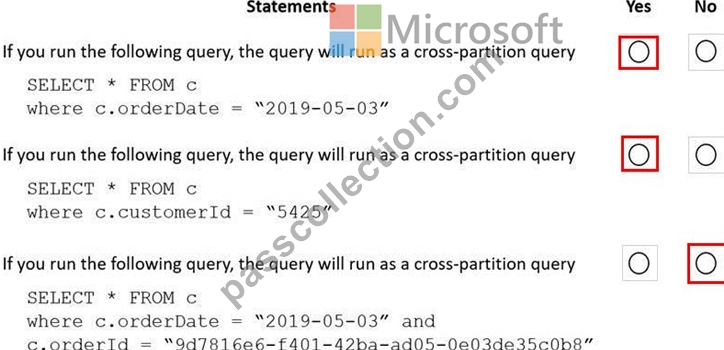
NEW QUESTION # 27
You have an application named App1 that reads the data in an Azure Cosmos DB Core (SQL) API account.
App1 runs the same read queries every minute. The default consistency level for the account is set to eventual.
You discover that every query consumes request units (RUs) instead of using the cache.
You verify the IntegratedCacheiteItemHitRate metric and the IntegratedCacheQueryHitRate metric. Both metrics have values of 0.
You verify that the dedicated gateway cluster is provisioned and used in the connection string.
You need to ensure that App1 uses the Azure Cosmos DB integrated cache.
What should you configure?
- A. the consistency level of the requests from App1
- B. the default consistency level of the Azure Cosmos DB account
- C. the connectivity mode of the App1 CosmosClient
- D. the indexing policy of the Azure Cosmos DB container
Answer: C
Explanation:
Explanation
Because the integrated cache is specific to your Azure Cosmos DB account and requires significant CPU and memory, it requires a dedicated gateway node. Connect to Azure Cosmos DB using gateway mode.
Reference: https://docs.microsoft.com/en-us/azure/cosmos-db/integrated-cache-faq
NEW QUESTION # 28
You have a container in an Azure Cosmos DB Core (SQL) API account. The container stores telemetry data from IoT devices. The container uses telemetryId as the partition key and has a throughput of 1,000 request units per second (RU/s). Approximately 5,000 IoT devices submit data every five minutes by using the same telemetryId value.
You have an application that performs analytics on the data and frequently reads telemetry data for a single IoT device to perform trend analysis.
The following is a sample of a document in the container.
You need to reduce the amount of request units (RUs) consumed by the analytics application.
What should you do?
- A. Move the data to a new container that has a partition key of deviceId.
- B. Increase the offerThroughput value for the container.
- C. Decrease the offerThroughput value for the container.
- D. Move the data to a new container that uses a partition key of date.
Answer: A
Explanation:
Explanation
The partition key is what will determine how data is routed in the various partitions by Cosmos DB and needs to make sense in the context of your specific scenario. The IoT Device ID is generally the "natural" partition key for IoT applications.
Reference: https://docs.microsoft.com/en-us/azure/architecture/solution-ideas/articles/iot-using-cosmos-db
NEW QUESTION # 29
You plan to create an Azure Cosmos DB Core (SQL) API account that will use customer-managed keys stored in Azure Key Vault.
You need to configure an access policy in Key Vault to allow Azure Cosmos DB access to the keys.
Which three permissions should you enable in the access policy? Each correct answer presents part of the solution.
NOTE: Each correct selection is worth one point.
- A. Verify
- B. Update
- C. Sign
- D. Get
- E. Unwrap Key
- F. List
- G. Wrap Key
Answer: D,E,G
NEW QUESTION # 30
You have a container named container1 in an Azure Cosmos DB Core (SQL) API account.
You need to provide a user named User1 with the ability to insert items into container1 by using role-based access control (RBAC). The solution must use the principle of least privilege.
Which roles should you assign to User1?
- A. CosmosDB Operator only
- B. DocumentDB Account Contributor and Cosmos DB Built-in Data Contributor
- C. DocumentDB Account Contributor only
- D. Cosmos DB Built-in Data Contributor only
Answer: A
Explanation:
Cosmos DB Operator: Can provision Azure Cosmos accounts, databases, and containers. Cannot access any data or use Data Explorer.
Incorrect Answers:
B: DocumentDB Account Contributor can manage Azure Cosmos DB accounts. Azure Cosmos DB is formerly known as DocumentDB.
C: DocumentDB Account Contributor: Can manage Azure Cosmos DB accounts.
NEW QUESTION # 31
You are implementing an Azure Data Factory data flow that will use an Azure Cosmos DB (SQL API) sink to write a dataset. The data flow will use 2,000 Apache Spark partitions.
You need to ensure that the ingestion from each Spark partition is balanced to optimize throughput.
Which sink setting should you configure?
- A. Batch size
- B. Throughput
- C. Write throughput budget
- D. Collection action
Answer: A
Explanation:
Explanation
Batch size: An integer that represents how many objects are being written to Cosmos DB collection in each batch. Usually, starting with the default batch size is sufficient. To further tune this value, note:
Cosmos DB limits single request's size to 2MB. The formula is "Request Size = Single Document Size * Batch Size". If you hit error saying "Request size is too large", reduce the batch size value.
The larger the batch size, the better throughput the service can achieve, while make sure you allocate enough RUs to empower your workload.
Reference: https://docs.microsoft.com/en-us/azure/data-factory/connector-azure-cosmos-db
NEW QUESTION # 32
You configure multi-region writes for account1.
You need to ensure that App1 supports the new configuration for account1. The solution must meet the business requirements and the product catalog requirements.
What should you do?
- A. Create a private endpoint connection.
- B. Increase the number of request units per second (RU/s) allocated to the con-product and con-productVendor containers.
- C. Set the default consistency level of accountl to bounded staleness.
- D. Modify the connection policy of App1.
Answer: B
Explanation:
Explanation
App1 queries the con-product and con-productVendor containers.
Note: Request unit is a performance currency abstracting the system resources such as CPU, IOPS, and memory that are required to perform the database operations supported by Azure Cosmos DB.
Scenario:
Develop an app named App1 that will run from all locations and query the data in account1.
Once multi-region writes are configured, maximize the performance of App1 queries against the data in account1.
Whenever there are multiple solutions for a requirement, select the solution that provides the best performance, as long as there are no additional costs associated.
Reference:
https://docs.microsoft.com/en-us/azure/cosmos-db/consistency-levels
NEW QUESTION # 33
You have an Azure Cosmos DB Core (SQL) account that has a single write region in West Europe.
You run the following Azure CLI script.
For each of the following statements, select Yes if the statement is true. Otherwise, select No.
NOTE: Each correct selection is worth one point.
Answer:
Explanation:
Explanation
Box 1: Yes
The Automatic failover option allows Azure Cosmos DB to failover to the region with the highest failover priority with no user action should a region become unavailable.
Box 2: No
West Europe is used for failover. Only North Europe is writable.
To Configure multi-region set UseMultipleWriteLocations to true.
Box 3: Yes
Provisioned throughput with single write region costs $0.008/hour per 100 RU/s and provisioned throughput with multiple writable regions costs $0.016/per hour per 100 RU/s.
Reference:
https://docs.microsoft.com/en-us/azure/cosmos-db/sql/how-to-multi-master
https://docs.microsoft.com/en-us/azure/cosmos-db/optimize-cost-regions
NEW QUESTION # 34
You have an Azure Cosmos DB Core (SQL) API account named storage1 that uses provisioned throughput capacity mode.
The storage1 account contains the databases shown in the following table.
The databases contain the containers shown in the following table.
For each of the following statements, select Yes if the statement is true. Otherwise, select No.
NOTE: Each correct selection is worth one point.
Answer:
Explanation:
Explanation
Box 1: No
Four containers with 1000 RU/s each.
Box 2: No
Max 8000 RU/s for db2. 8 containers, so 1000 RU/s for each container.
Box 3: Yes
Max 8000 RU/s for db2. 8 containers, so 1000 RU/s for each container. Can very well add an additional container.
Reference:
https://docs.microsoft.com/en-us/azure/cosmos-db/plan-manage-costs
https://azure.microsoft.com/en-us/pricing/details/cosmos-db/
NEW QUESTION # 35
You configure multi-region writes for account1.
You need to ensure that App1 supports the new configuration for account1. The solution must meet the business requirements and the product catalog requirements.
What should you do?
- A. Create a private endpoint connection.
- B. Increase the number of request units per second (RU/s) allocated to the con-product and con-productVendor containers.
- C. Set the default consistency level of accountl to bounded staleness.
- D. Modify the connection policy of App1.
Answer: B
Explanation:
App1 queries the con-product and con-productVendor containers.
Note: Request unit is a performance currency abstracting the system resources such as CPU, IOPS, and memory that are required to perform the database operations supported by Azure Cosmos DB.
Scenario:
Develop an app named App1 that will run from all locations and query the data in account1.
Once multi-region writes are configured, maximize the performance of App1 queries against the data in account1.
Whenever there are multiple solutions for a requirement, select the solution that provides the best performance, as long as there are no additional costs associated.
Reference:
https://docs.microsoft.com/en-us/azure/cosmos-db/consistency-levels
NEW QUESTION # 36
You have an Azure Cosmos DB database named databaset contains a container named container1. The container1 container store product data and has the following indexing policy.
Which path will be indexed?
- A. /product/brand/tailspin
- B. /product/brand
- C. /product/[ ]/category
- D. /product/category
Answer: B
Explanation:
Explanation
The indexing policy has an includedPaths array that contains only one path: /product/brand/? . This means that only the properties under /product/brand will be indexed. The ? symbol indicates that only scalar values will be indexed, not arrays or objects1.
The excludedPaths array contains a single path: /* . This means that all other properties will be excluded from indexing. The * symbol indicates a wildcard that matches any property name1.
Therefore, the paths /product/category , /product/[ ]/category , and /product/brand/tailspin will not be indexed.
NEW QUESTION # 37
......
The Microsoft DP-420 certification exam is designed for professionals who want to prove their expertise in designing and implementing cloud-native applications using Microsoft Azure Cosmos DB. This exam is ideal for developers, architects, and IT professionals who want to demonstrate their skills in building scalable, highly available, and fault-tolerant applications on the Azure platform. With this certification, professionals can demonstrate their understanding of Azure Cosmos DB's features, including its NoSQL database capabilities, multi-model data support, and global distribution.
DP-420 Dumps and Exam Test Engine: https://examtests.passcollection.com/DP-420-valid-vce-dumps.html
