

Get EMT Actual Free Exam Q&As to Prepare for Your NREMT Certification
NREMT Actual Free Exam Questions And Answers
NEW QUESTION # 30
When treating a patient suspected of having tuberculosis, you should
- A. Place a surgical mask on the patient
- B. Notify the Centers for Disease Control
- C. Wear a surgical mask before treating the patient
- D. Place a HEPA respirator on the patient
Answer: A
Explanation:
Comprehensive and Detailed Explanation From Exact Extract:
Forsuspected or confirmed tuberculosis (TB), the EMT should place asurgical mask on the patient, not a HEPA respirator. Surgical masks are used tocontain droplets from the patientand reduce airborne transmission.
The EMTshould wear aN95 or HEPA respiratorto protect against inhaling airborne particles. Notification to the CDC is not the EMT's responsibility - that falls to public health officials.
References:
CDC Guidelines for TB Exposure in Prehospital Settings
NREMT Infectious Disease Control Protocols
National EMS Education Standards - Airborne Pathogens and PPE Use
NEW QUESTION # 31
A 20-year-old patient has just given birth. The neonate is crying and has central cyanosis. They have a pulse greater than 100. Which of the following actions should the EMT take? Select the three answer options that are correct.
- A. Dry baby.
- B. Administer blow-by oxygen.
- C. Suction the nose and mouth.
- D. Give positive pressure ventilations.
- E. Provide chest compressions.
- F. Keep baby warm.
Answer: A,B,F
Explanation:
According to NREMT neonatal resuscitation principles, a newborn who is crying with a heart rate greater than 100 does not require aggressive resuscitation but does need supportive care.
Option A (Dry baby) is essential to stimulate breathing and prevent heat loss.
Option B (Keep baby warm) is critical, as neonates lose heat rapidly and hypothermia worsens hypoxia.
Option C (Administer blow-by oxygen) is appropriate for central cyanosis when respirations and heart rate are adequate.
Option D is only indicated if secretions are obstructing the airway.
Options E and F are contraindicated because the infant has an adequate heart rate and is breathing.
NREMT emphasizes warmth, oxygenation, and minimal intervention in stable newborns.
NEW QUESTION # 32
An EMS unit is dispatched to a mass casualty incident along with police and fire resources. Which command structure, singular or unified, should the crew expect to find in use?
- A. Singular, because the fire department has the ultimate authority.
- B. Unified, because there are multiple agencies represented.
- C. Unified, because the EMS unit will join the command team upon arrival.
- D. Singular, because there is still only one incident commander.
Answer: B
Explanation:
When an incident involves multiple agencies with shared responsibility, NREMT teaches that a Unified Command structure is used. This allows police, fire, EMS, and other agencies to work together under a common set of objectives while maintaining their individual authority.
Option C is correct because the defining feature of unified command is multi-agency involvement, not rank or arrival order.
Option A is incorrect because no single agency automatically has authority.
Option B misunderstands unified command, which still functions with coordinated leadership.
Option D is incorrect because EMS does not automatically become part of command.
NREMT emphasizes unified command to improve coordination, communication, and safety during MCIs.
NEW QUESTION # 33
A 56-year-old patient has a severe headache. The patient is refusing any treatment or transport. The vital signs are BP 210/140 mmHg, P 112/min, R 20/min, and SpO# 98% on room air. Which of the following actions should the EMT perform next?
- A. Have the patient sign a refusal.
- B. Request law enforcement assistance.
- C. Obtain a repeat set of vital signs.
- D. Determine if the patient has decision-making capacity.
Answer: D
Explanation:
NREMT guidelines emphasize that patient refusal is only valid if the patient has decision-making capacity
. This patient has a severe headache with critically elevated blood pressure, which raises concern for conditions such as hypertensive emergency, intracranial hemorrhage, or stroke-all of which can impair cognition.
Option D is correct because the EMT must first determine whether the patient is alert, oriented, understands the risks, and can communicate a rational decision. Without capacity, a refusal is not legally or ethically valid.
Option A is incorrect because a refusal form should only be signed after capacity is confirmed.
Option B does not address the legal and ethical priority.
Option C is unnecessary unless the patient lacks capacity and poses a danger to themselves or others.
NREMT stresses that EMTs must protect patient autonomy while ensuring informed refusal, especially in high-risk presentations.
NEW QUESTION # 34
A 70-year-old patient has lower back pain radiating to the left side of their chest that started one day ago. The pain has become progressively worse and is not relieved by changes in position. The patient has no prescribed medications. Palpation of the abdomen reveals a pulsating mass. The vital signs are BP 104/66, P 64, R 16, and SpO# 89% on room air. Which of the following interventions are appropriate for this patient? Select two.
- A. Attaching AED pads
- B. Supplemental oxygen
- C. Position of comfort
- D. Aspirin administration
- E. Sublingual nitroglycerin
Answer: B,C
Explanation:
This patient's presentation-older age, severe back pain radiating to the chest, hypotension, and a pulsating abdominal mass-is highly suggestive of an abdominal aortic aneurysm (AAA). NREMT teaching stresses early recognition of life-threatening medical conditions and avoiding interventions that could worsen the patient's condition.
Option A (Position of comfort) is correct because patients with suspected AAA should be kept calm and positioned in a way that minimizes pain and stress, which can reduce sympathetic stimulation and the risk of aneurysm rupture.
Option D (Supplemental oxygen) is correct because the patient's SpO# is 89%, indicating hypoxia. NREMT guidelines recommend administering oxygen to maintain adequate oxygenation in critically ill or potentially unstable patients.
Option B is incorrect because AED pads are not indicated unless the patient is in cardiac arrest or has a high risk of imminent arrest. There is no evidence of dysrhythmia or arrest at this time.
Option C is incorrect because aspirin is indicated for suspected acute coronary syndromes, not AAA. Aspirin could worsen internal bleeding if the aneurysm ruptures.
Option E is incorrect because nitroglycerin can cause vasodilation and hypotension, potentially precipitating aneurysm rupture.
In summary, NREMT emphasizes supportive care, oxygenation, and rapid transport for suspected AAA while avoiding medications that increase bleeding risk or lower blood pressure.
NEW QUESTION # 35
A 34-year-old patient has a possible midshaft fracture to their right femur. The EMT is considering what the best time to assess distal neurological function would be:
* Time 1: Before the splint has been applied
* Time 2: After the splint has been applied
At which of these times, if either, should the EMT assess distal neurological function?
- A. Time 1 only
- B. Both times
- C. Time 2 only
- D. Neither time
Answer: B
Explanation:
Comprehensive and Detailed Explanation (Based on NREMT standards):
NREMT trauma care guidelines clearly state that distal circulation, sensation, and motor function (CSM) must be assessed both before and after splinting any musculoskeletal injury.
Option C is correct because the pre-splint assessment establishes a baseline, while the post-splint assessment confirms that the splint has not compromised blood flow or nerve function.
Option A is incomplete and unsafe.
Option B misses baseline data.
Option D violates standard trauma care practices.
Proper documentation of distal neurological status is critical for patient safety and medico-legal protection.
NEW QUESTION # 36
Through which of the following routes is hepatitis A transmitted?
- A. Blood
- B. Fecal
- C. Saliva
- D. Urine
Answer: B
Explanation:
Comprehensive and Detailed Explanation From Exact Extract:
Hepatitis Avirus is transmittedexclusively via the fecal-oral route. Ingesting contaminated food or water allows the virus to enter the digestive tract, infecting liver cells. It's often spread through poor hand hygiene or unsanitary food handling.
It isnot bloodborne, unlike Hepatitis B and C. It is not commonly spread through saliva or urine.
References:
CDC: "Hepatitis A - Questions and Answers for Health Professionals"
NREMT Medical Guidelines - Communicable Disease
National EMS Education Standards - Infection Control and Prevention
NEW QUESTION # 37
What patient conditions have an indication for the use of a CPAP device? Select the three answer options that are correct.
- A. Spontaneous pneumothorax
- B. Pulmonary edema
- C. Pulmonary edema from burns
- D. Acute myocardial infarction
- E. Acute bronchospasms
- F. Chronic bronchitis
Answer: B,E,F
Explanation:
Comprehensive and Detailed Explanation (Based on NREMT standards):
Continuous Positive Airway Pressure (CPAP) is used in patients with moderate to severe respiratory distress who are conscious and able to maintain their airway. NREMT guidelines identify specific respiratory conditions where CPAP improves oxygenation and ventilation.
Option A (Chronic bronchitis) is correct because CPAP helps overcome airway collapse and improves gas exchange in COPD patients.
Option B (Pulmonary edema) is correct because CPAP reduces preload and afterload while forcing fluid out of alveoli, improving oxygenation.
Option C (Acute bronchospasms) is correct because CPAP helps splint open airways and reduce work of breathing.
Option D is incorrect because CPAP is not used for isolated myocardial infarction without respiratory failure.
Option E is contraindicated because positive pressure can worsen a pneumothorax.
Option F is contraindicated due to airway burns and potential inhalation injury.
NREMT stresses proper patient selection to prevent CPAP-related complications.
NEW QUESTION # 38
An EMT cannot find a pulse on a responsive patient. Which of the following should the EMT do next?
- A. Continue with the primary assessment.
- B. Place the patient supine with feet elevated.
- C. Use the AED to analyze rhythm.
- D. Start CPR.
Answer: A
Explanation:
If a patient is responsive, they must have adequate cerebral perfusion, meaning a pulse is present-even if it is difficult to palpate. NREMT guidelines emphasize that EMTs should not assume cardiac arrest based solely on an inability to feel a pulse.
Option C is correct because the EMT should continue the primary assessment, reassessing airway, breathing, and circulation using additional indicators such as skin condition, mental status, and breathing quality.
Option A is incorrect because CPR is only initiated in unresponsive, pulseless patients.
Option B is incorrect because AED use is indicated only for unresponsive, pulseless patients.
Option D may be appropriate later for shock but does not address the assessment discrepancy.
NREMT teaches that patient responsiveness is a reliable indicator of circulation and that EMTs must avoid unnecessary resuscitative interventions.
NEW QUESTION # 39
An EMT has just assisted with the delivery of a newborn. At the five-minute mark, the neonate is completely pink with a pulse of 108/min. The neonate has some flexion of their extremities, but the breathing is still slow.
How should the EMT score the following categories of the APGAR scale? Select the correct value for each sign.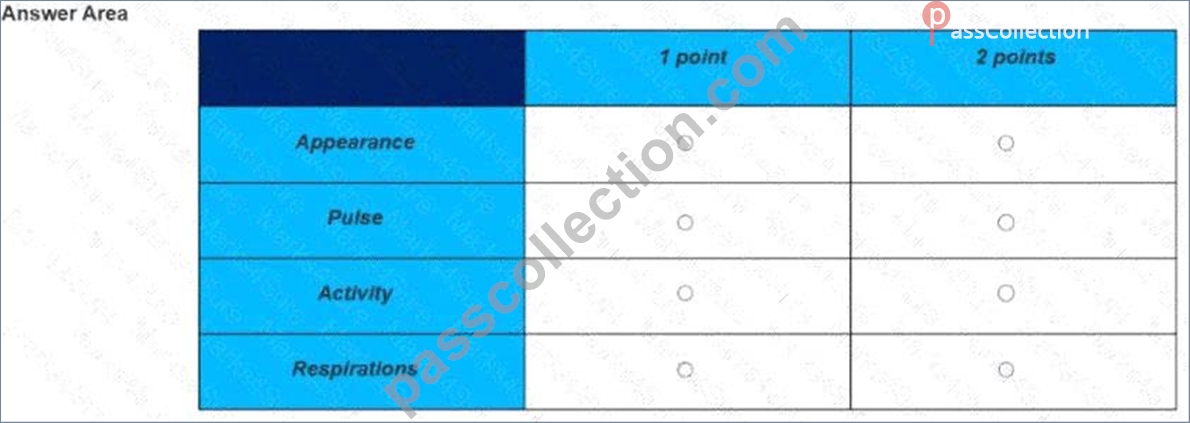
Answer:
Explanation: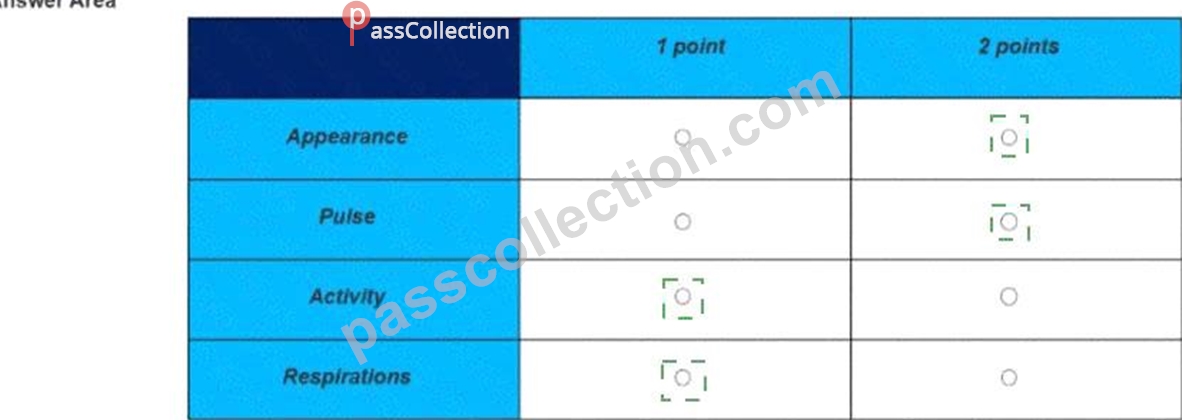
Explanation: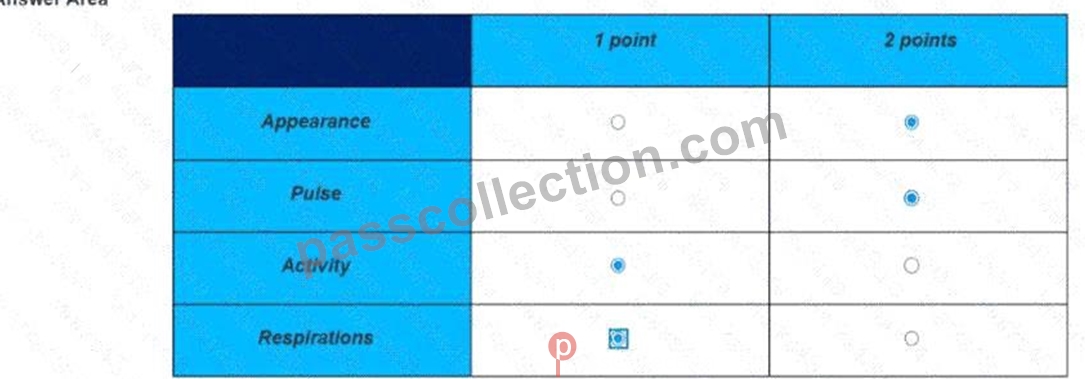
Appearance (Skin Color): # 2 points
* The neonate is completely pink.
* APGAR criteria:
* 0 = blue/pale
* 1 = pink body, blue extremities
* 2 = completely pink
Pulse (Heart Rate): # 2 points
* Heart rate is 108/min.
* APGAR criteria:
* 0 = absent
* 1 = < 100/min
* 2 = # 100/min
Activity (Muscle Tone): # 1 point
* The neonate has some flexion of extremities, but not active motion.
* APGAR criteria:
* 0 = limp
* 1 = some flexion
* 2 = active motion
Respirations: # 1 point
* Breathing is slow, not strong crying.
* APGAR criteria:
* 0 = absent
* 1 = slow or irregular respirations
* 2 = strong cry
Total APGAR Score at 5 Minutes: 6 / 10
Interpretation (NREMT-based):
* A score of 6 indicates the newborn requires continued supportive care, such as warming, positioning, stimulation, and close monitoring.
* No immediate chest compressions are indicated because the heart rate is >100/min.
* Respiratory effort should continue to be assessed closely.
This scoring aligns with NREMT neonatal assessment and APGAR scoring guidelines used for evaluating newborn transition after birth.
NEW QUESTION # 40
An 83-year-old patient is unresponsive and lying on the floor. The patient has a large bruise and laceration on the forehead. The patient's vital signs are BP 90/60 mmHg, P 126/min, and R 0. Which of the following conditions should the EMT most suspect?
- A. Commotio cordis
- B. Spine injury
- C. Open pneumothorax
- D. Brain herniation
Answer: D
Explanation:
This patient presents with severe head trauma, unresponsiveness, hypotension, tachycardia, and apnea (R =
0). NREMT education stresses that apnea following head injury is a critical red flag for increased intracranial pressure (ICP) and potential brain herniation.
Option B is correct because brain herniation occurs when swelling or bleeding within the skull forces brain tissue downward, compressing the brainstem. Compression of the brainstem can result in loss of respiratory drive, explaining the absence of respirations. Elderly patients are at increased risk due to cerebral atrophy and fragile bridging veins.
Option A is possible but does not directly explain apnea.
Option C is associated with sudden cardiac arrest after chest impact, not head trauma.
Option D would present with respiratory compromise but not directly from a forehead injury.
NREMT emphasizes rapid airway management, ventilation, spinal precautions, and immediate transport for suspected brain herniation.
NEW QUESTION # 41
A 3-year-old patient has a sore throat and fever. They are drooling. Which of the following actions should the EMT take?
- A. Administer oxygen via BVM.
- B. Perform a finger sweep.
- C. Inspect the airway for swelling.
- D. Transport in a position of comfort.
Answer: D
Explanation:
This pediatric presentation-fever, sore throat, and drooling-is highly concerning for acute epiglottitis, a life-threatening airway emergency emphasized in NREMT airway education. Epiglottitis causes rapid swelling of the epiglottis and surrounding tissues, which can lead to sudden and complete airway obstruction, especially in young children.
Option D is correct because the EMT should minimize agitation and transport the child in a position of comfort, typically sitting upright. NREMT guidelines stress that children with suspected epiglottitis should be kept calm, allowed to assume their preferred position, and transported rapidly without unnecessary interventions that could provoke airway spasm.
Option A is incorrect because finger sweeps are contraindicated unless a solid foreign body is clearly visible.
Performing a finger sweep may worsen obstruction or trigger complete airway closure.
Option B is incorrect because positive-pressure ventilation with a BVM can increase agitation and is not indicated unless the patient is in respiratory failure. Oxygen may be offered gently, but forcing a BVM is dangerous.
Option C is incorrect because visual inspection of the airway using a tongue depressor can precipitate sudden airway obstruction and is specifically contraindicated by NREMT teaching.
The priority per NREMT is airway preservation through calm handling, rapid transport, and avoidance of invasive airway maneuvers.
NEW QUESTION # 42
While responding to an emergency, a car is tailgating the ambulance. Which of the following actions should the EMT take?
- A. Slow down
- B. Tap the brakes
- C. Speed up
- D. Pull over
Answer: B
Explanation:
Comprehensive and Detailed Explanation From Exact Extract:
In situations where a vehicle is tailgating an emergency unit, tapping the brakes briefly is a standard defensive driving maneuver to alert the driver behind to increase distance. It is less risky than slowing dramatically or pulling over, which could endanger crew or delay response.
Speeding up could reduce your reaction window or increase accident risk. EMS operators must follow safe driving practices per NFPA 1002 and DOT Emergency Vehicle Operation Guidelines.
References:
NREMT Operations Section - Driving and Scene Safety
NFPA 1002: Standard for Fire Apparatus Driver/Operator Professional Qualifications
U.S. DOT: Emergency Vehicle Operator Course (EVOC)
NEW QUESTION # 43
A 44-year-old patient with diabetes feels weak and dizzy. The EMT provides oral glucose and transports the patient to the hospital, where the patient recovers. The EMT tells their partner they did not provide the patient with a blanket because they felt the patient was wasting their time. What best describes the action the EMT took?
- A. Breach of duty
- B. Breach of ethics
- C. Battery
- D. Negligence
Answer: D
Explanation:
Comprehensive and Detailed Explanation From Exact Extract:
Negligenceoccurs when an EMT:
* Has aduty to act
* Breaches that duty(e.g., by withholding basic care like warmth)
* Causesharm or risk of harm
* Establishescausation
The EMT's failure to treat the patient with respect and dignity - even if the patient improved - still constitutesnegligence, especially if tied to a discriminatory or dismissive attitude.
References:
NREMT Ethics & Legal Guidelines - Duty and Negligence
National EMS Education Standards - Professional Conduct
Brady Emergency Care (13th ed.), Chapter: Legal and Ethical Responsibilities
NEW QUESTION # 44
A 10-year-old patient is unresponsive in a park. What locations should the EMT use to assess for the presence of a pulse? Select the two answer options that are correct.
- A. Femoral
- B. Popliteal
- C. Carotid
- D. Brachial
- E. Radial
Answer: A,C
Explanation:
Comprehensive and Detailed Explanation (Based on NREMT standards):
For unresponsive children, NREMT guidelines recommend checking central pulses to determine circulation.
Option B (Carotid) is correct and is the preferred pulse site for children over 1 year old.
Option C (Femoral) is also acceptable as a central pulse, especially if the carotid pulse is difficult to locate.
Option A is a peripheral pulse and unreliable in shock.
Option D is used for infants under 1 year.
Option E is not used for pulse assessment.
Accurate pulse assessment guides CPR decisions and must be completed within 10 seconds.
NEW QUESTION # 45
During a mass casualty incident, a patient has an open tibia and fibula deformity. Using START triage, in which of the following priorities should the EMT place the patient?
- A. Emergent
- B. Immediate
- C. Delayed
- D. Minimal
Answer: C
Explanation:
Comprehensive and Detailed Explanation From Exact Extract:
TheSTART (Simple Triage and Rapid Treatment)system classifies patients based on ability to walk, respirations, perfusion, and mental status. A patient with an open fracture who can breathe adequately, has a pulse, and follows commands is categorized as"Delayed".
Immediate (Red) is reserved for those who cannot walk and have life-threatening conditions, such as compromised airway or severe bleeding.
References:
U.S. Department of Health START Triage Protocol
FEMA MCI Guidelines
Brady Emergency Care (13th ed.) - Chapter on MCI and Incident Management
NEW QUESTION # 46
A 26-year-old male is choking. He is awake and has no air movement. He has a history of morbid obesity.
You should
- A. Lay him down and perform back slaps.
- B. Perform abdominal thrusts while he is standing.
- C. Perform chest thrusts while he is standing.
- D. Lay him down and perform abdominal thrusts.
Answer: C
Explanation:
Comprehensive and Detailed Explanation (Based on NREMT standards):
For a conscious adult with complete airway obstruction, abdominal thrusts are typically indicated. However, NREMT guidelines specify that chest thrusts should be used instead for patients who are morbidly obese or pregnant, because abdominal thrusts may be ineffective or unsafe.
Option D is correct because chest thrusts provide effective airway clearance while accommodating body habitus.
Options A and B are inappropriate for a conscious patient.
Option C is incorrect because abdominal thrusts may not be effective in morbidly obese patients.
NREMT stresses modifying airway obstruction techniques based on patient size and condition.
NEW QUESTION # 47
Which of the following is spread through the fecal-oral route?
- A. Hepatitis D
- B. Hepatitis A
- C. Hepatitis B
- D. Hepatitis C
Answer: B
Explanation:
Comprehensive and Detailed Explanation (Based on NREMT standards):
Hepatitis A is a viral liver infection transmitted primarily through the fecal-oral route, often due to contaminated food, water, or poor hand hygiene. NREMT education highlights hepatitis transmission routes as part of infection control and standard precautions.
Option A is correct because hepatitis A spreads when microscopic amounts of fecal matter are ingested, commonly in environments with inadequate sanitation.
Options B, C, and D are incorrect because these forms of hepatitis are transmitted primarily through blood and body fluids, such as needlestick injuries, sexual contact, or shared needles.
Understanding transmission routes allows EMTs to apply proper protective measures and reduce occupational exposure risks, a core component of NREMT infection-control training.
NEW QUESTION # 48
A 78-year-old female tripped and fell while walking. Her left leg is rotated externally and shorter than her right leg. You should suspect
- A. Posterior hip dislocation
- B. Proximal femur fracture
- C. Colles' fracture
- D. Pelvic fracture
Answer: B
Explanation:
Comprehensive and Detailed Explanation From Exact Extract:
Anexternally rotated, shortened legis a classic sign of aproximal femur fracture, specifically afemoral neck or intertrochanteric fracture, commonly seen in elderly fall patients. This presentation reflectsmuscle pulland fracture displacement.
* Posterior hip dislocationscauseinternal rotation.
* Pelvic fracturesmay cause instability but not specific leg rotation/shortening.
* Colles' fractureis a distal radius (wrist) injury, unrelated to leg trauma.
References:
NREMT Trauma Module - Musculoskeletal Injuries
National EMS Education Standards - Geriatric Trauma
AAOS Emergency Care (11th ed.), Chapter: Orthopedic Injuries
NEW QUESTION # 49
A law enforcement officer requests that you place the clothes from a sexual assault victim in a bag for transport to the hospital. Which type of bag should you use?
- A. Plastic
- B. Polypropylene
- C. Paper
- D. Cloth
Answer: C
Explanation:
Comprehensive and Detailed Explanation From Exact Extract:
In cases ofsexual assault, preservingevidence integrityis critical. Clothing or other forensic evidence must be placed inpaper bags. Plastic or non-breathable materials can trap moisture, promotingmold or degradation of evidencelike DNA or bodily fluids.
This approach follows chain-of-custody protocols used by law enforcement and medical facilities for handling forensic material.
References:
NREMT EMS Operations - Evidence Preservation and Forensics
U.S. Department of Justice: "A National Protocol for Sexual Assault Medical Forensic Examinations" National EMS Education Standards - Legal and Ethical Principles
NEW QUESTION # 50
A 7-year-old patient is confused and disoriented. What should the EMT assess to rapidly determine the patient's condition? Select the three answer options that are correct.
- A. Response to environment
- B. Accessory muscle use
- C. Mucous membranes
- D. Pallor
- E. Lung sounds
- F. Disability
Answer: A,B,D
Explanation:
To rapidly determine a pediatric patient's condition, NREMT emphasizes the Pediatric Assessment Triangle (PAT), which allows EMTs to form a quick clinical impression without hands-on assessment. The PAT consists of appearance, work of breathing, and circulation to skin.
Option F (Response to environment) evaluates appearance, including interaction, awareness, and mental status-critical in a confused child.
Option E (Accessory muscle use) assesses work of breathing, identifying respiratory compromise through visible effort such as retractions or nasal flaring.
Option A (Pallor) reflects circulation to skin, helping identify poor perfusion or shock.
Options B, C, and D are part of more detailed assessments but are not part of the rapid initial determination emphasized by NREMT.
Using the PAT allows EMTs to quickly identify life-threatening problems and prioritize care.
NEW QUESTION # 51
What are possible complications of using continuous positive airway pressure (CPAP)? Select the two correct options.
- A. Pulmonary edema
- B. Hypotension
- C. Feeling of suffocation
- D. Bronchospasms
- E. Myocardial infarction
Answer: B,C
Explanation:
Comprehensive and Detailed Explanation From Exact Extract:
CPAPworks by delivering continuous positive pressure to keep alveoli open and improve oxygenation.
However, complications include:
* Hypotension: Due to reduced venous return and cardiac preload
* Feeling of suffocation: Common psychological reaction to a tight-fitting mask and forced airflow It isused to treat, not cause, pulmonary edema. It doesnot induce bronchospasmor myocardial infarction.
References:
NREMT Airway & Ventilation Guidelines
National EMS Education Standards - Noninvasive Positive Pressure Ventilation AAOS EMT Textbook (11th ed.), CPAP and Respiratory Distress Management
NEW QUESTION # 52
......
EMT Questions Truly Valid For Your NREMT Exam: https://examtests.passcollection.com/EMT-valid-vce-dumps.html
