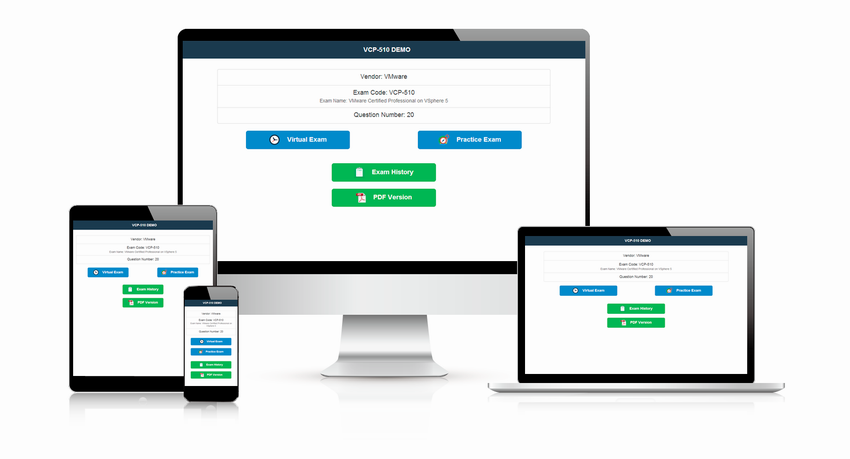
Choosing a version is a preference, not a gamble. Try the PassCollection demo in each format; the 42 practice questions are identical, so the only variable is which screen — or page — you like best.
ISQI CT-GenAI Exam Syllabus Topics:
| Section | Weight | Objectives |
|---|---|---|
| Topic 1: Prompt Engineering for Effective Software Testing | 35% | - Principles and structure of effective prompts - Prompt patterns for test design, data generation, automation - Iterative refinement and evaluation of prompts |
| Topic 2: LLM-Powered Test Infrastructure | 10% | - RAG, fine-tuning, and model adaptation - AI agents and integration with test tools - Architecture and deployment considerations |
| Topic 3: Introduction to Generative AI for Software Testing | 15% | - Core concepts: Generative AI, LLMs, foundation models - Use cases across the testing lifecycle - Capabilities and limitations relevant to testing |
| Topic 4: Managing Risks of Generative AI in Software Testing | 25% | - Hallucinations, bias, inaccuracy, and consistency risks - Validation, verification, and mitigation strategies - Data privacy, security, and compliance concerns |
| Topic 5: Deploying and Integrating GenAI in Test Organisations | 15% | - Measuring value and continuous improvement - Strategy, governance, and adoption roadmap - Roles, skills, and team readiness |
ISQI ISTQB Certified Tester Testing with Generative AI (CT-GenAI) v1.0 Exam: Three Versions, Zero Worries
Three versions of the same study materials: a printable, expert-prepared PDF with free demo download and instant access; a Desktop Test Engine for Windows with customizable simulation and timed modes that works offline; and an Online Test Engine for any browser on Windows, Mac, Android, and iOS with test history and performance review. All 42 practice questions are identical across versions. Every purchase includes 365 days of free updates, a 50% renewal discount afterward, and unlimited computer installations.
The ISQI ISTQB Certified Tester Testing with Generative AI (CT-GenAI) v1.0 exam requires 30 / 46 points (65%) to pass, and registration costs ~150 - 200 USD (varies by region). A failed attempt means paying the same fee again — a readiness check with the PassCollection engines before booking is the cheaper option.
The CT-GenAI exam is a ISQI certification exam validating the ISQI ISTQB Certified Tester Testing with Generative AI (CT-GenAI) v1.0 syllabus shown above. It belongs to these credential paths: ISTQB Certified Tester Foundation Level (CTFL), ISTQB Advanced Level Certifications, ISTQB Expert Level Certifications. Candidates in 2026 start with PassCollection's 42 practice questions, available as a printable PDF, a Windows Desktop Test Engine, and an Online Test Engine — three versions of the same materials.
PassCollection issues a full refund if you take the ISQI ISTQB Certified Tester Testing with Generative AI (CT-GenAI) v1.0 exam within 60 days of purchase and do not pass. The policy does not apply if the exam is taken within 3 days of purchase, if the exam was never actually taken, or to free materials or expired orders, and the candidate name must match the payer name. Submit a scan of your enrollment slip and the official Score Report PDF within 2 days of the exam; claims are processed within 7 days. Alternatively, exchange for two free exam products of equal value and keep your original update service. Orders arrive by email within 1 minute — contact support if nothing arrives within 2 hours.
The official ISQI ISTQB Certified Tester Testing with Generative AI (CT-GenAI) v1.0 outline defines 5 domains. The leading three are Introduction to Generative AI for Software Testing (15%), Deploying and Integrating GenAI in Test Organisations (15%), and Managing Risks of Generative AI in Software Testing (25%). The full list is in the topics section above, and PassCollection's 42 practice questions cover each one.
Must hold ISTQB Certified Tester Foundation Level (CTFL) certification Since requirements change over time, confirm the latest on the official ISQI exam page before scheduling.
The ISQI ISTQB Certified Tester Testing with Generative AI (CT-GenAI) v1.0 exam contains 40 to complete within 60 (+25% for non-native language speakers). Timed simulation in the PassCollection Desktop Test Engine teaches that rhythm before exam day does.
ISQI recommends these training resources for the ISQI ISTQB Certified Tester Testing with Generative AI (CT-GenAI) v1.0 exam:
Follow the training with steady self-testing — the 42 practice questions from PassCollection help you apply theory and fill any gaps the training leaves.
Online remote proctored (iSQI FLEX) or in-person at test centres Register for the ISQI ISTQB Certified Tester Testing with Generative AI (CT-GenAI) v1.0 exam through these official channels:
After booking, PassCollection delivers your practice questions within 1 minute — preparation starts the same day.
ISQI ISTQB Certified Tester Testing with Generative AI (CT-GenAI) v1.0 Sample Questions:
A prompt section states: "Web checkout module v3.2; focus on coupon application; existing regression suite IDs T-112-T-150; recent defect ID BUG-431." Which component is this?
- A. Input data
- B. Instruction
- C. Output format
- D. Constraints
Correct Answer: A 🗳️
Explanation: Only visible for PassCollection members. You can sign-up / login (it's free).
Which option BEST differentiates the three prompting techniques?
- A. Few-shot = no examples; Chaining = single prompt; Meta = disable iteration
- B. Few-shot = examples; Chaining = multi-step prompts; Meta = model helps draft/refine prompts
- C. Meta = step decomposition; Chaining = zero-shot only; Few-shot = manual optimization
- D. Chaining = give examples; Few-shot = break tasks; Meta = manual edits only
Correct Answer: B 🗳️
Explanation: Only visible for PassCollection members. You can sign-up / login (it's free).
Which setting can reduce variability by narrowing the sampling distribution during inference?
- A. Increasing learning rate
- B. Lowering temperature
- C. Using a larger context window
- D. Increasing temperature
Correct Answer: B 🗳️
Explanation: Only visible for PassCollection members. You can sign-up / login (it's free).
What distinguishes an LLM-powered agent from a basic AI chatbot in test processes?
- A. Ability to respond to prompts without explicit user instructions
- B. Ability to trigger automated actions beyond conversation
- C. Use of a conversational tone and improved response personalization
- D. Reliance on predefined templates to generate short, factual answers
Correct Answer: B 🗳️
What distinguishes an LLM-powered agent from a basic AI chatbot in test processes?
- A. Ability to respond to prompts without explicit user instructions
- B. Ability to trigger automated actions beyond conversation
- C. Use of a conversational tone and improved response personalization
- D. Reliance on predefined templates to generate short, factual answers
Correct Answer: B 🗳️
Explanation: Only visible for PassCollection members. You can sign-up / login (it's free).


 Bernie
 Marian
  Conrad
 David
David  Simona
 Corey
Corey  Amy
Amy  Athena
  Barton
  Enid
Enid  Blanche
  Jesse
Jesse  Tracy
Tracy  Camille
  Marcia
  Madge
Madge